

Fresh health and wellness news from Massachusetts
Provided by AGP
Tracheobronchial Stents Market to Reach US$ 220.1 Million by 2033 at 7.2% CAGR | Persistence Market Research
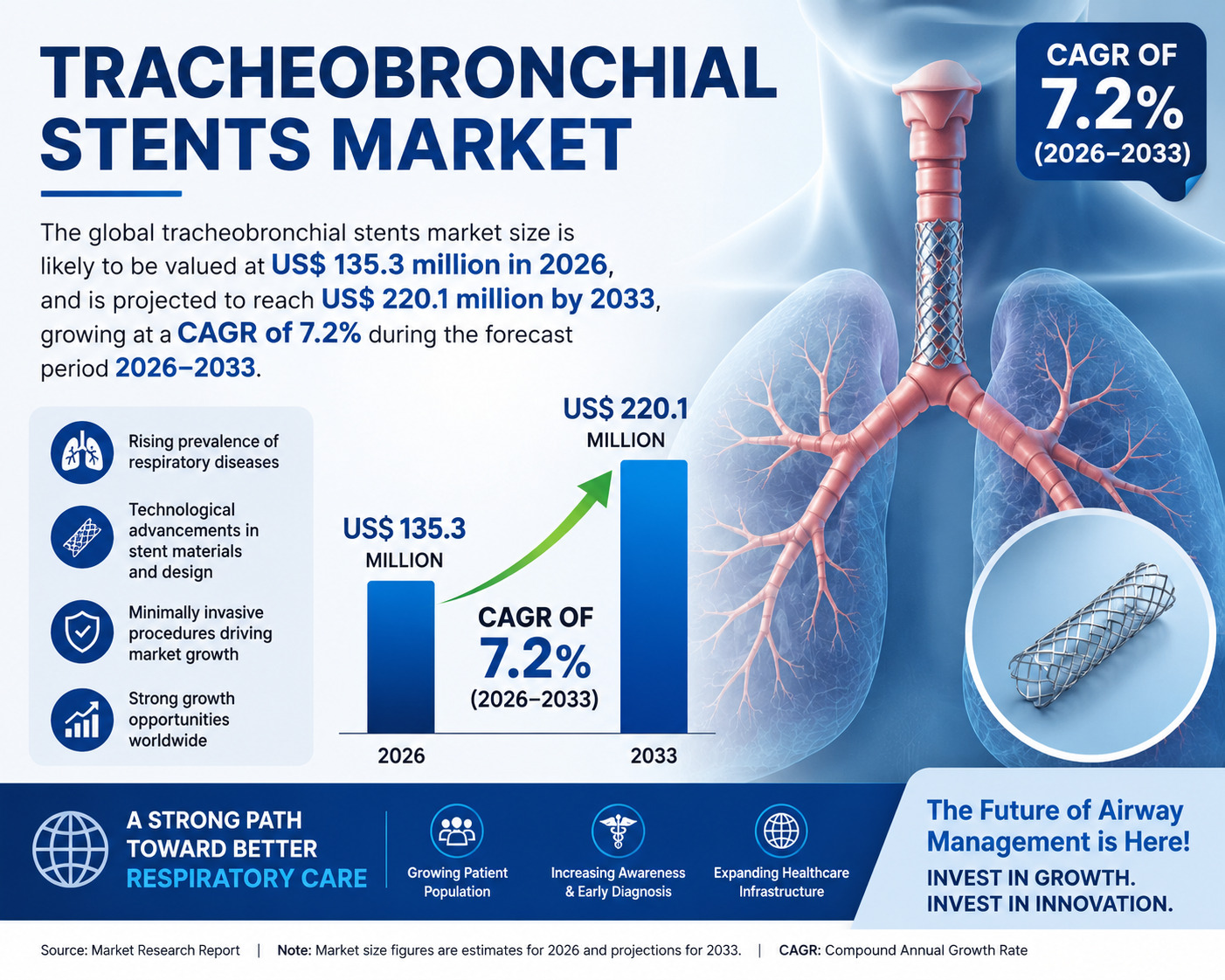
Tracheobronchial Stents Market
BRENFORD, LONDON, UNITED KINGDOM, May 18, 2026 /EINPresswire.com/ -- The global tracheobronchial stents market is gaining steady momentum as hospitals, interventional pulmonology centers, and thoracic care specialists increasingly adopt airway stenting solutions for managing complex airway obstructions. Tracheobronchial stents are used to keep the trachea and bronchial passages open in patients facing narrowing, compression, or blockage caused by malignant and benign conditions. Rising awareness of minimally invasive airway management, growing respiratory disease burden, and improvements in stent design are supporting demand across healthcare settings. disease management.
According to Persistence Market Research, the global tracheobronchial stents market size is likely to be valued at US$ 135.3 million in 2026 and is projected to reach US$ 220.1 million by 2033, growing at a CAGR of 7.2% during the forecast period 2026−2033. Market growth is being driven by increasing cases of airway obstruction, lung cancer-related complications, post-surgical airway narrowing, and chronic respiratory disorders. Silicone and metallic stents continue to play important roles, with product selection depending on disease type, airway anatomy, physician preference, and patient condition. Hospitals are expected to remain a leading end-user segment due to access to advanced bronchoscopy units and emergency airway care.
Want Market Insights? Get Your Free Report Sample : https://www.persistencemarketresearch.com/samples/32742
Key Highlights from the Report
➤ The global tracheobronchial stents market is likely to reach US$ 135.3 million in 2026 and is projected to reach US$ 220.1 million by 2033, growing at a CAGR of 7.2% during 2026−2033.
➤ Rising prevalence of airway obstruction caused by lung cancer, tumors, trauma, and post-intubation complications is strengthening demand for tracheobronchial stents.
➤ Increasing use of bronchoscopy-guided procedures is improving the placement accuracy of airway stents and supporting better patient outcomes.
➤ Hospitals remain a key demand center due to the availability of pulmonary specialists, intensive care units, and advanced interventional respiratory care facilities.
Customize This Report for Your Exact Requirements : https://www.persistencemarketresearch.com/request-customization/32742
Market Segmentation
The tracheobronchial stents market can be segmented by product type, material, application, and end-user. By product type, the market includes silicone stents, metallic stents, and hybrid stents. Silicone stents are often preferred where removability, flexibility, and long-term airway support are important. Metallic stents are used in cases requiring strong radial force and stable airway expansion, especially when airway compression is severe. Hybrid stents are gaining attention as they combine useful features of different materials to improve clinical performance. Product choice depends on obstruction location, patient condition, expected duration of use, and physician expertise.
By application, the market covers malignant airway obstruction, benign airway stenosis, tracheomalacia, bronchomalacia, and post-surgical airway complications. Malignant airway obstruction represents a significant area of use due to rising cancer-related respiratory complications. By end-user, hospitals, specialty clinics, and ambulatory surgical centers contribute to demand. Hospitals lead the market because airway stenting often requires specialized imaging, bronchoscopy, anesthesia support, and emergency care readiness. Specialty clinics are also expanding their role as interventional pulmonology services become more accessible. This segmentation shows that market growth is closely linked to both clinical complexity and healthcare infrastructure.
Regional Insights
North America is expected to remain a leading region in the tracheobronchial stents market due to advanced respiratory care infrastructure, higher adoption of interventional pulmonology procedures, and strong availability of trained specialists. The region benefits from well-equipped hospitals, early diagnosis of airway diseases, and broader access to minimally invasive treatment options.
Europe also represents a significant market, supported by advanced hospital networks, growing use of bronchoscopy procedures, and increasing focus on improving quality of life for patients with airway obstruction. Asia Pacific is expected to show strong growth potential due to improving healthcare infrastructure, rising respiratory disease burden, and expanding access to advanced pulmonary care.
Unlock Complete Insights – Buy the Full Report : https://www.persistencemarketresearch.com/checkout/32742
Market Drivers
One of the major drivers of the tracheobronchial stents market is the rising incidence of airway obstruction linked to malignant and benign conditions. Lung cancer, thyroid cancer, esophageal cancer, and metastatic tumors can compress or invade the airway, creating life-threatening breathing difficulties. In such cases, tracheobronchial stents provide immediate airway support and help restore airflow. The growing burden of respiratory disorders, combined with aging populations and higher cancer diagnosis rates, is increasing the need for effective airway management.
Another key driver is the increasing preference for minimally invasive procedures. Bronchoscopy-guided stent placement allows physicians to treat airway narrowing without requiring highly invasive surgical intervention. This approach can reduce recovery time, improve patient comfort, and support faster clinical decision-making in urgent cases. Improvements in stent materials, imaging support, and procedural techniques are also making airway stenting more reliable.
Market Restraints
Despite positive growth prospects, the tracheobronchial stents market faces challenges related to procedural complexity and clinical complications. Stent migration, mucus plugging, granulation tissue formation, infection risk, and airway irritation can affect treatment outcomes. These complications require careful patient selection, skilled placement, and regular follow-up. In some cases, stent removal or replacement may be needed, increasing the overall treatment burden. The requirement for experienced interventional
Market Opportunities
The tracheobronchial stents market offers strong opportunities in product innovation and personalized airway care. Manufacturers are focusing on stents with better flexibility, improved biocompatibility, reduced migration risk, and easier removal. Customized stents designed according to patient-specific airway anatomy could gain greater importance as imaging and 3D planning technologies improve.
Emerging markets present another major opportunity as healthcare systems invest in advanced respiratory care and cancer treatment infrastructure. Rising awareness of interventional pulmonology, expanding hospital networks, and growing availability of diagnostic bronchoscopy can increase procedure volumes. Training programs for pulmonologists and thoracic specialists may further support adoption.
Company Insights
Key players operating in the tracheobronchial stents market include Boston Scientific Corporation, Cook Medical, Merit Medical Systems, Micro-Tech Endoscopy, EFER Endoscopy, Novatech SA, Taewoong Medical Co., Ltd., Medtronic plc, Teleflex Incorporated, Olympus Corporation, and Fuji Systems Corporation.
Explore the Latest Trending Research Reports:
Direct-to-consumer Pet food market
Pharmacogenetic Tests Market
Persistence Market Research
Persistence Market Research Pvt Ltd
+1 646-878-6329
email us here
Visit us on social media:
LinkedIn
Instagram
Facebook
YouTube
X
Legal Disclaimer:
EIN Presswire provides this news content "as is" without warranty of any kind. We do not accept any responsibility or liability for the accuracy, content, images, videos, licenses, completeness, legality, or reliability of the information contained in this article. If you have any complaints or copyright issues related to this article, kindly contact the author above.
